Too little
Borrowed importance
A grand subject will make the picture serious.
Prestige takes the place of a felt reason for the work.
The teapot has a dent. That is partly why you want to paint it.
Readiness to express one's actual convictions and intentions without pretense.
Sincerity gives form to something you actually mean, notice or care about. In creative work it connects the choices on the page, stage or canvas with a real intention. That intention may be playful or fictional: an invented dragon can carry an honest feeling. What matters is that a borrowed fashionable attitude does not substitute for your own attention.
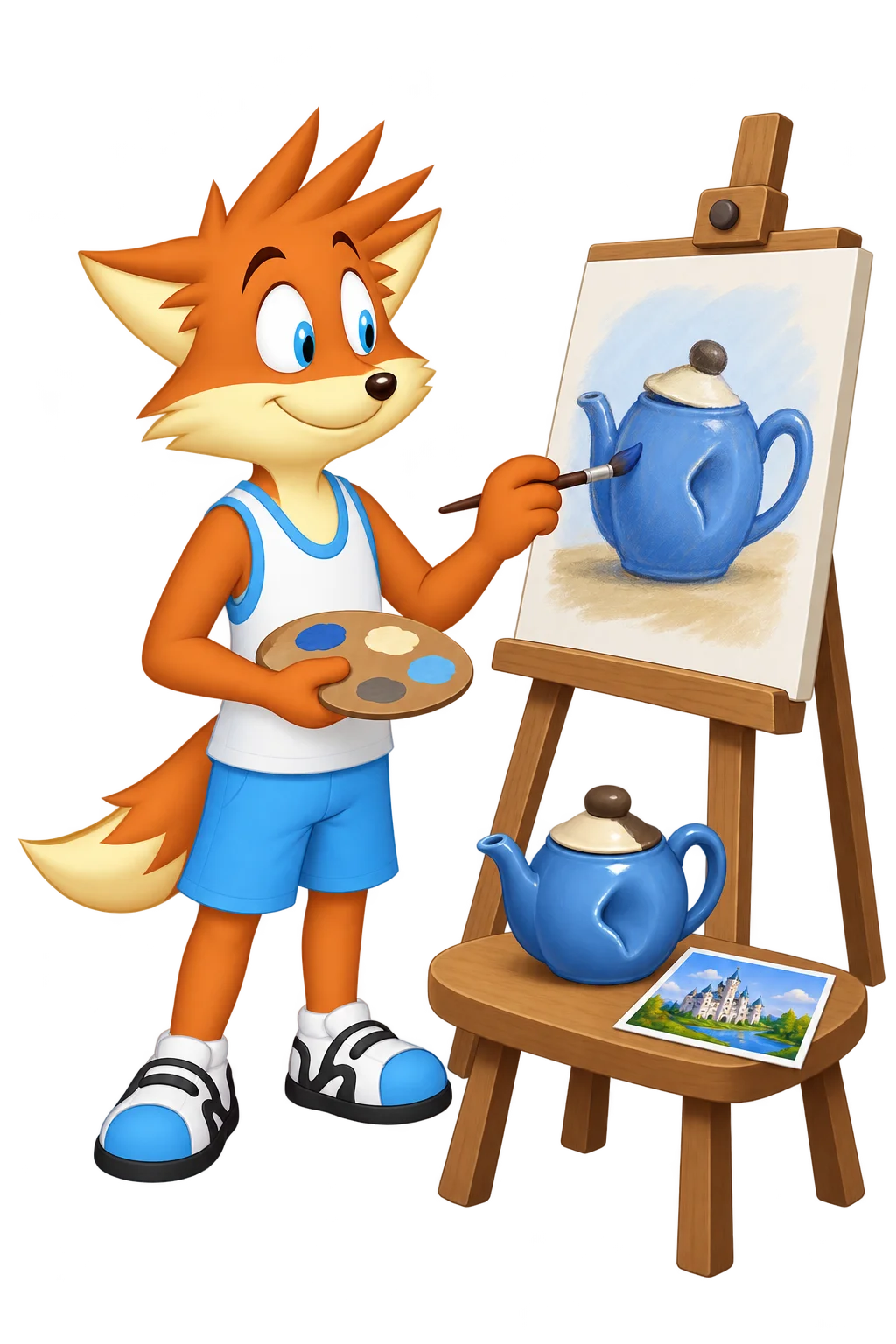
A glossy picture suggests a splendid castle. On your table sits the blue teapot used through years of ordinary conversations, wearing a lid that does not quite match. You choose the pot. Its dent interrupts the graceful curve, and you paint that too. The pot is not a lesser subject awaiting promotion to a palace. Your interest gives you something particular to discover in its shape and history.
An illustrative everyday situation
Paint the familiar dented teapot that matters to you instead of borrowing a fashionable grand subject.
Too little
A grand subject will make the picture serious.
Prestige takes the place of a felt reason for the work.
A fitting response
I want to show why this familiar object holds my attention.
The actual interest guides choices of shape, color and emphasis.
Pursued too far
If I felt it, every mark must stay.
The first impulse is excused from the work of communication.
An ordinary subject can carry an exact affection.
While drawing, you discover that the picture concerns the empty chair beside the pot more than the pot itself. Revise the composition to follow that discovery. Sincerity need not freeze your first explanation.
The work can gain a voice through specific choices: a remembered rhythm, an awkward silence, an observed color. Sincerity supplies reasons to revise because you want the thing meant to become more clearly available to someone else.
Give an invented character a response you have thought through, rather than the speech that currently sounds impressive.
You copy an admired photographer’s dramatic treatment, then notice that it hides the doorway that first caught your eye. Try a quieter framing that lets the doorway matter. Learning through imitation can teach a method; decide what you actually want that method to express.
Integrity keeps a considered artistic commitment under pressure. Sincerity concerns whether the expression is actually meant.
Attentiveness notices what is there. Sincerity lets a genuine interest inform what you make of it.
Imitating a popular conviction to win approval is a counterfeit of Sincerity. Genuine expression has reasons beyond the reaction it hopes to purchase.
Calling every disclosure sincere can confuse Sincerity with exposure. A truthful artistic voice can use selection, fiction and privacy.
Identify the particular thing you want to express.
Find a concrete image, sound or action that could carry it.
Revise what merely advertises a feeling without helping the audience encounter it.
Sincerity does not require autobiography, confession or disclosure. Fiction and privacy can coexist with an honestly held intention.
Make a short study of something that actually interests you. Choose one detail because it matters to your intention, then develop it. You can invent or transform the subject; keep other people’s private material out of the exercise.
Give form to something you actually mean.
Which choice belongs to my actual interest?
What am I adding only to make the work seem important?
Sincerity does not require autobiography, confession or disclosure. Fiction and privacy can coexist with an honestly held intention.
About these practices · DisclaimerSeven selections to return to through the week. Follow a source link to read the surrounding passage.
seeing it for yourself, and loving it, not merely taking up the thoughts of other people about it;
Ruskin asks why the reader wants to learn drawing. This fragment concerns a sincere response to paintings; the same attention helps a maker choose a subject that actually matters to them.
To ape a sentiment, even a good one, is to travesty a sentiment; that will not be helpful.
Stevenson considers a writer’s responsibility to express an actual view. Borrowed nobility can make a work less truthful than a modest subject honestly felt.
That thing which I understand by real art is the expression by man of his pleasure in labour.
This is Morris’s account of art, not a requirement that every creative hour feel happy. It gives room to the maker’s own enjoyment of a humble subject or material.
You wrote with no thoughts of fame and money, and put your heart into it, my daughter.
Louisa May Alcott · Little Women · CHAPTER FORTY-TWO ALL ALONE · English original · excerpt
Mr. March responds to a story Jo wrote for her family. The novel does not make paid work insincere; this scene shows how a subject close to her experience gives her voice life.
Here and there I see what takes me at once as noble—something that I might compare with the Alban Mountains or the sunset from the Pincian Hill;
George Eliot · Middlemarch · CHAPTER XXII. · English original, 1871–1872 · excerpt
Dorothea explains her own uneven response to celebrated art. Sincerity can begin by recognizing what actually moves you, before borrowing an approved opinion.
I desire therein to be viewed as I appear in mine own genuine, simple, and ordinary manner, without study and artifice: for it is myself I paint.
Montaigne introduces the personal purpose of his essays. This is an authored self-portrait, not proof of artlessness; it invites the maker to begin with something actually known and felt.
Poetry is the spontaneous overflow of powerful feelings: it takes its origin from emotion recollected in tranquillity:
Wordsworth connects poetic feeling with recollection and the work of composition. His account makes room for an honestly felt subject to acquire form over time, rather than equating sincerity with an unedited first outpouring.
Read freely, follow the fourteen-virtue program, or adapt this collection in My Virtues. Begin with a piece you want to make.