Too little
Unexamined appetite
“I want it, so I need it now.”
The moment’s appeal stands in for a decision.
Let desire speak without letting it decide alone.
Readiness to moderate appetites rather than let them dominate judgment.
Here the appetite is the pull of acquiring: the new colour, the complete set, the brief pleasure of a parcel arriving. Enjoyment is allowed. The question is whether wanting something has crowded out your other reasons.
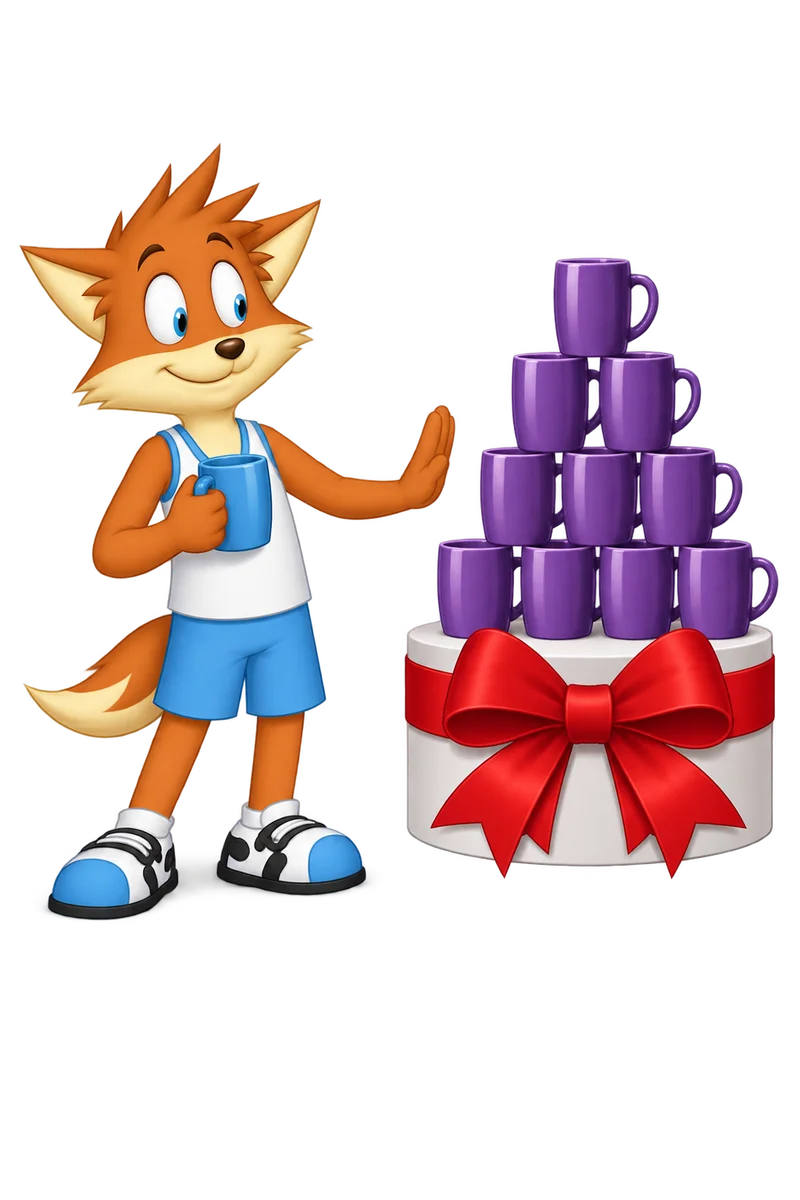
You came for a replacement cup and discovered a complete philosophy of happiness in twelve matching mugs. The display promises a new morning routine; your cupboard offers a more cautious review. A pause lets the imagined life and the actual shelf meet.
An illustrative everyday situation
An attractive new notebook appears beside several unused ones.
Too little
“I want it, so I need it now.”
The moment’s appeal stands in for a decision.
A fitting response
“I like it. Does it have a place in what I actually do?”
Pleasure remains a reason, alongside space, use and other commitments.
Pursued too far
“Wanting anything is a failure.”
An ordinary pleasure becomes an occasion for punishment.
Moderation leaves room for a real yes as well as a considered no.
If a notebook genuinely supports something you want to do and fits your means, buying it need not defeat the practice. A rule that forbids every purchase can become another way of avoiding judgment.
A small interval can make a choice more deliberate. It does not guarantee freedom from advertising or turn spending into a character score. Sometimes the discovery is simply that looking was enough.
You enjoy a beautifully made object without treating admiration as a purchase order.
Before downloading another attractive app or opening a nonessential shopping recommendation, pause and notice what you expect it to supply. You might mute one unwanted promotional prompt while keeping wanted access, important records and essential communication.
Frugality concerns waste; temperance concerns an appetite’s place in a decision.
Prudence considers likely consequences; temperance helps desire leave room for that consideration.
Refusing harmless pleasure to appear disciplined is a counterfeit of temperance. A smaller appetite for objects can coexist with a larger appetite for admiration.
An elaborate compensating purchase can imitate moderation while leaving the same impulse in command. Look at the whole choice.
Name what attracts you before deciding.
Notice whether you want the object, the imagined identity or the event of buying.
Choose a pause suited to an ordinary nonessential purchase.
Use ordinary nonessential possessions as examples. Do not restrict food, medication or needed supports as a virtue exercise; clinical concerns are not a test of willpower.
For one nonessential object, write down privately what you expect it to do. Reconsider after the immediate excitement has passed.
Pause the appetite before making the purchase.
What am I hoping this purchase will change?
Could I enjoy this without having to own it?
Use ordinary nonessential possessions as examples. Do not restrict food, medication or needed supports as a virtue exercise; clinical concerns are not a test of willpower.
About these practices · DisclaimerSeven selections to return to through the week. Follow a source link to read the surrounding passage.
If you are struck by the appearance of any promised pleasure, guard yourself against being hurried away by it; but let the affair wait your leisure, and procure yourself some delay.
Epictetus · Enchiridion · Enchiridion §34 · excerpt
A pause makes room for judgment before a nonessential purchase. The page does not adopt the surrounding emphasis on self-reproach or make abstinence the only good result.
Shall we always study to obtain more of these things, and not sometimes to be content with less?
Henry David Thoreau · Walden · Economy; household furniture · excerpt
Thoreau questions automatic accumulation. The question concerns chosen sufficiency, not the adequacy of another person’s resources.
a man is rich in proportion to the number of things which he can afford to let alone.
Henry David Thoreau · Walden · Where I Lived, and What I Lived For; imagined farms · excerpt
After imaginatively enjoying farms without buying them, Thoreau finds value in leaving things alone. Enjoying an object need not lead to ownership.
He who is satisfied with his lot is rich;
Laozi · Tao Te Ching · Tao Teh King §33.1 · excerpt
This historical account of sufficiency challenges the appetite for more. It is not a claim that deprivation is good or that legitimate unmet needs should be ignored.
he enjoyed them without affectation, and when he had them not, he did not want them.
Marcus Aurelius · Meditations · Meditations I.16; recollection of Antoninus · excerpt
Marcus admires enjoyment without display or dependence in his adoptive father. The portrait offers a contrast with acquisition for status, not a test of anyone’s ability to do without essentials.
So convenient a thing it is to be a reasonable creature, since it enables one to find or make a reason for everything one has a mind to do.
Benjamin Franklin · Autobiography · Part I, the fish dinner · excerpt
Franklin notices how reasoning can serve a desire already chosen. A persuasive explanation for a purchase may still deserve a second look.
all this is not luxury, if it be done for beauty’s sake, and not for show:
William Morris · Hopes and Fears for Art · The Beauty of Life; decoration and simplicity · excerpt
Morris allows deliberate pleasure in beauty. Moderation need not turn into a contest in bare walls or joylessness.
Read freely, follow the thirteen-virtue program, or adapt this collection in My Virtues. There is no target for the number of things you own.